FHIR in US Healthcare: A Technical Deep Dive into Real-Time Healthcare Interoperability
- Ramesh Prajapati

- Jul 30, 2025
- 3 min read
Updated: Nov 13, 2025

As the healthcare industry continues shifting toward real-time data sharing and patient-centric models, FHIR (Fast Healthcare Interoperability Resources) is emerging as a transformative force, offering flexibility, scalability, and modern web-based architecture. This article takes a technical deep dive into implementing FHIR in US healthcare, including its core use cases, tools, real-time capabilities, comparison with X12, handling large data sets, and securing APIs.
What Is FHIR?
FHIR is a standards-based framework developed by HL7 for exchanging healthcare information electronically. It uses modern technologies like RESTful APIs, JSON/XML, and a modular resource model, making it easier for developers and systems to work with healthcare data.
FHIR supports a wide range of clinical and administrative scenarios, including:
Clinical Data
Patient: Demographics
Observation: Lab results, vitals
Condition: Diagnoses
MedicationRequest: Prescriptions
CarePlan, Procedure, Immunization, etc.
Administrative Data
Coverage: Insurance information
Claim/ClaimResponse: Billing and payment
Appointment, Schedule, Invoice
Organization, Practitioner
FHIR in US Healthcare: The Core Building Blocks
FHIR defines over 150 resource types, each representing a piece of healthcare information. These modular resources are the foundation for all interactions.
Common FHIR Resources:
Resource | Description |
Patient | Demographics and identifiers |
Encounter | Visit details |
Condition | Diagnosed medical issues |
Observation | Vitals, labs, and measurements |
MedicationRequest | Prescriptions |
AllergyIntolerance | Allergy info |
Immunization | Vaccination record |
CarePlan | Plan of treatment |
Procedure | Performed medical procedures |
Coverage | Insurance and plan details |
Claim | Billing information (replacing X12 837) |
ClaimResponse | Claim adjudication (replacing X12 835) |
ExplanationOfBenefit | Summary of benefits used |
Organization | Hospitals, payers, facilities |
Practitioner | Providers, doctors, nurses |
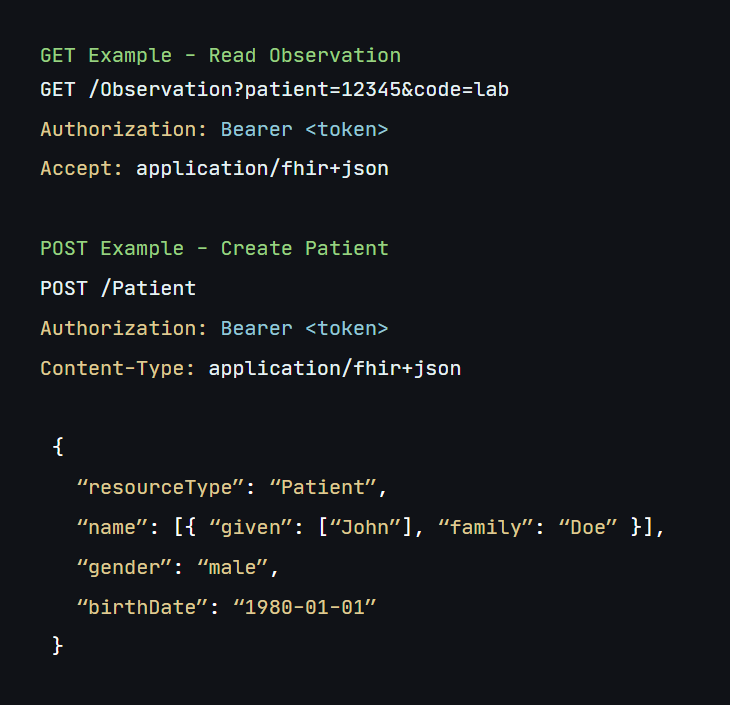
Resources are accessed and manipulated via REST endpoints like:
GET /Patient/{id}POST /ObservationPUT /Condition/{id}DELETE /Appointment/{id}FHIR Use Cases Across the Ecosystem
Stakeholder | Use Case | FHIR Resource |
Patients | Access medical records | Patient, Observation, Condition |
Providers | Share referral info | CarePlan, Encounter, DocumentReference |
Payers | Process eligibility & claims | CoverageEligibilityRequest, Claim, ClaimResponse |
Public Health | Disease surveillance | Observation, DiagnosticReport |
Researchers | Analyze de-identified data | $export, ResearchStudy |
Developers | SMART on FHIR apps | Launch, Auth, Patient context |
FHIR is also being adopted for:
Remote patient monitoring
Clinical decision support
Prior authorization (Da Vinci Project)
Bulk export for analytics
Authentication & Authorization
FHIR APIs must be secured to comply with HIPAA, SOC 2, and other standards.
Common Mechanisms:
OAuth 2.0 - The foundation for SMART on FHIR
SMART on FHIR – Adds scopes (patient/*.read), launch context, OpenID Connect
Mutual TLS (mTLS) – For server-to-server secure communication
API Keys & JWTs – For internal and service account interactions
SMART on FHIR also adds layers like:
App registration
Scopes for granular access control (e.g., patient/Observation.read)
Identity federation with OpenID Connect
Handling Large Datasets in FHIR
FHIR addresses scalability challenges using:
Pagination (_count, link.relation=next)
Bulk Data Export ($export) – Used by CMS and payers
Incremental Queries (_since)
Transaction Bundles – Batch submission of resources
Subscriptions – Real-time push notifications via WebSocket or REST hooks
Source of FHIR Data
FHIR servers can source data from:
Internal EHR systems (e.g., Epic, Cerner, Allscripts)
Data lakes or warehouses (e.g., AWS HealthLake)
Clinical databases or APIs
Third-party integration engines
You can:
Host your own FHIR server (e.g., HAPI FHIR, Microsoft OSS FHIR server)
Query external FHIR APIs (e.g., CMS, payers, HealthLake)
Note: AWS HealthLake is account-specific; you can't query external patients across tenants. You load data into it to run analytics, NLP, and search.
FHIR Tools and SDKs
HAPI FHIR (Java) – Open-source FHIR server and client
Vonk (Firely) – .NET-based commercial server
Smile CDR – Enterprise-grade FHIR platform
Postman Collections – For FHIR API testing
Inferno & Touchstone – FHIR conformance and interoperability test platforms
FHIR.js, FHIRKitClient (Node.js) – JavaScript SDKs for client apps
What is SMART on FHIR?
SMART (Substitutable Medical Applications, Reusable Technologies) is a security and app framework that builds on FHIR to enable third-party apps to integrate securely with EHRs and FHIR APIs.
Features:
OAuth 2.0 + OpenID Connect
Scopes (e.g., read/write)
Standard launch contexts (e.g., patient-level or user-level)
Widely used in mobile health apps and patient portals
Sample FHIR API Signatures
Conclusion
FHIR is transforming healthcare data exchange in the US by offering real-time, secure, and modular APIs. Whether you're working with clinical records or administrative claims, FHIR provides the modern foundation for interoperability, helping bridge gaps between providers, payers, and patients.
While X12 EDI remains part of the legacy infrastructure, FHIR is the future, powering apps, analytics, and payer-provider collaboration in a more connected healthcare ecosystem.
About the Author

Ramesh Prajapati
Solutions Architect | Novelty Technology
Connect with Ramesh on LinkedIn


